Showing posts with label 3-2 IT e-books. Show all posts
UML 2 Toolkit ( UML ) - Hans Erik Eriksson, Magnus Penker, Brian Lyons, David Fado, e-book free download
E-Book Details:
Title: | The Unified Modeling Language (UML) - UML 2 Toolkit |
Publisher: | Wiley |
Author: | Hans Erik Eriksson, Magnus Penker, Brian Lyons, David Fado |
Edition: | Paperback, 2ndedition (October 13, 2003) |
Format: | Pdf |
ISBN: | 0471463612 |
EAN: | 978-0471463610 |
No. of Pages: | 552 |
Book Description:
Gain the skills to effectively plan software applications and systems using the latest version of UML
UML 2 represents a significant update to the UML specification, from providing more robust mechanisms for modeling workflow and actions to making the modeling language more executable. Now in its second edition, this bestselling book provides you with all the tools you’ll need for effective modeling with UML 2. The authors get you up to speed by presenting an overview of UML and its main features. You’ll then learn how to apply UML to produce effective diagrams as you progress through more advanced topics such as use-case diagrams, classes and their relationships, dynamic diagrams, system architecture, and extending UML. The authors take you through the process of modeling with UML so that you can successfully deliver a software product or information management system.
With the help of numerous examples and an extensive case study, this book teaches you how to:
- Organize, describe, assess, test, and realize use cases
- Gain substantial information about a system by using classes
- Utilize activity diagrams, state machines, and interaction diagrams to handle common issues
- Extend UML features for specific environment or domains
- Use UML as part of a Model Driven Architecture initiative
- Apply an effective process for using UML
ABOUT THE AUTHORS:
HANS-ERIK ERIKSSON has more than 15 years of experience in system development and software architecture. He is the author of six books in the field, including Business Modeling with UML: Business Practices at Work (Wiley).
MAGNUS PENKER is senior advisor and consultant to both public authorities and international top management and has over 10 years’ experience in business processes and object-oriented analysis and design.
BRIAN LYONS is Chairman, CTO, and co-founder of Number Six Software, Inc., a Washington, D.C.-based software development outsourcing company. Mr. Lyons is a leading expert in object-oriented technology and iterative development techniques.
DAVID FADO works as a software architect for Number Six Software, Inc., focusing on information and financial management systems as well as simulations. Dr. Fado has relied on UML and development support tools for many successful projects.
MAGNUS PENKER is senior advisor and consultant to both public authorities and international top management and has over 10 years’ experience in business processes and object-oriented analysis and design.
BRIAN LYONS is Chairman, CTO, and co-founder of Number Six Software, Inc., a Washington, D.C.-based software development outsourcing company. Mr. Lyons is a leading expert in object-oriented technology and iterative development techniques.
DAVID FADO works as a software architect for Number Six Software, Inc., focusing on information and financial management systems as well as simulations. Dr. Fado has relied on UML and development support tools for many successful projects.
Table of Contents:
Organization and Special Features
The user guide is organized into seven major sections:
· Section 1 Getting Started
· Section 2 Basic Structural Modeling
· Section 3 Advanced Structural Modeling
· Section 4 Basic Behavioral Modeling
· Section 5 Advanced Behavioral Modeling
· Section 6 Architectural Modeling
· Section 7 Wrapping Up
The user guide contains three appendices: a summary of the UML notation, a list of standard UML elements, and a summary of the Rational Unified Process. A glossary of common terms is also provided.
Each chapter addresses the use of a specific UML feature, and most are organized into the following four sections:
1. Getting Started
2. Terms and Concepts
3. Common Modeling Techniques
4. Hints and Tips
The third section introduces and then solves a set of common modeling problems. To make it easy for you to browse the guide in search of these use cases for the UML, each problem is identified by a distinct heading.
Each chapter begins with a summary of the features it covers, as in the following example.
In this chapter
· Active objects, processes, and threads
· Modeling multiple flows of control
· Modeling interprocess communication
· Building thread-safe abstractions
Similarly, parenthetical comments and general guidance are set apart as notes
Labels,
3-2 CSE e-books
,
3-2 IT e-books
,
DRAFTSS
The Essential Guide to User Interface Design by Wilbert o.galitz, e-book free download
E-Book Details:
Title: | THE ESSENTIAL GUIDE TO USER INTERFACE DESG. (2nd ED |
Publisher: | Wiley India Pvt Ltd |
Author: | Wilbert O. Galitz |
Edition: | Paperback,2nd edition (June 2002) |
Format: | .pdf |
ISBN: | 8126502800 |
EAN: | 9788126502806, 978-8126502806 |
No. of Pages: | 736 |
Book Description:
Well-designed graphical user interfaces (GUIs) for business systems can greatly increase user productivity, but designing them can be difficult and time consuming. This book walks developers through the basics of good interface design, using real-world examples from systems that are proven successes.
* Galitz is an internationally recognized consultant, author, and instructor with many years of experience with information systems and user interface design
* Written especially for developers who may be designing user interfaces for the first time, but also extremely useful for any developer involved in GUI or Web site design
* Revised to reflect the profound enhancements in interface design, specifically how Web page design has revolutionized interface design
* New information covers a variety of platforms, both traditional and Web-based
* Galitz is an internationally recognized consultant, author, and instructor with many years of experience with information systems and user interface design
* Written especially for developers who may be designing user interfaces for the first time, but also extremely useful for any developer involved in GUI or Web site design
* Revised to reflect the profound enhancements in interface design, specifically how Web page design has revolutionized interface design
* New information covers a variety of platforms, both traditional and Web-based
This Second Edition, provides a comprehensive, step-by-step guide to building user-friendly system interfaces. At each step, the author describes the principles of good design and illustrates them with real-world examples of proven designs. He provides in-depth examples of the key components of interfaces and how they can be combined to promote efficient use. This book is especially written for developers who may be designing user interfaces for the first time.
ABOUT THE AUTHORS:
Wilbert O. Galitz is an internationally recognized consultant, author, and instructor on information systems and user interface design. He is president of Galitz, Inc., a firm that focuses on the human factors and ergonomics of systems.
Table of Contents:
Preface
Acknowledgments
About the Authors
Part I: The User Interface -An Introduction and Overview
· The Importance of the User Interface
· Characteristics of Graphical and Web User Interfaces
Part II: The User Interface Design Process
· Know Your User or Client
· Understand the Business Function
· Understand the Principles of Good Screen Design
· Develop System Menus and Navigation Schemes
· Select the Proper Kinds of Windows
· Select the Proper Device-Based Controls
· Choose the Proper Screen-Based Controls
· Writing Clear Text and Messages
· Provide Effective Feedback, Guidance, and Assistance
· Provide Effective Internationalization and Accessibility
· Create Meaningful Graphics, Icons and Images
· Choose the Proper Colors
· Organize and Layout Windows and Pages
· Test, Test, and Retest
References
Index
Preface
Acknowledgments
About the Authors
Part I: The User Interface -An Introduction and Overview
· The Importance of the User Interface
· Characteristics of Graphical and Web User Interfaces
Part II: The User Interface Design Process
· Know Your User or Client
· Understand the Business Function
· Understand the Principles of Good Screen Design
· Develop System Menus and Navigation Schemes
· Select the Proper Kinds of Windows
· Select the Proper Device-Based Controls
· Choose the Proper Screen-Based Controls
· Writing Clear Text and Messages
· Provide Effective Feedback, Guidance, and Assistance
· Provide Effective Internationalization and Accessibility
· Create Meaningful Graphics, Icons and Images
· Choose the Proper Colors
· Organize and Layout Windows and Pages
· Test, Test, and Retest
References
Index
Labels,
3-2 CSE e-books
,
3-2 IT e-books
,
DRAFTSS
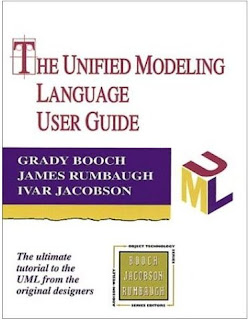
The Unified Modeling Language (UML) by Grady Booch, Dr. James Rumbaugh, Dr. Jacobson, e-book free download
E-Book Details:
Title: | The Unified Modeling Language (UML) |
Publisher: | Addison-Wesley Professional |
Author: | Grady Booch, Dr. James Rumbaugh, Dr. Jacobson |
Edition: | Hardcover, 1 edition (September 30, 1998) |
EditionNumber: | Updated 2009 |
ISBN: | 0-201-57168-4 |
EAN: | 978-0201571684 |
No. of Pages: | 512 |
Book Description:
The Unified Modeling Language (UML) is a graphical language for visualizing, specifying, constructing, and documenting the artifacts of a software-intensive system. The UML gives you a standard way to write a system's blueprints, covering conceptual things, such as business processes and system functions, as well as concrete things, such as classes written in a specific programming language, database schemas, and reusable software component. The "Unified Modeling Language User Guide" is the first of two UML works written by the creators of UML. This book will introduce the core 80% of UML, approaching it in a layered fashion and providing numerous examples of its application. The title is suitable for developers unfamiliar with UML or with modeling in general.
ABOUT THE AUTHORS:
Grady Booch, is the Chief Scientist at Rational Software Corporation and developer of the Booch Method of object-oriented analysis and design. He is also co-developer of the Unified Modeling Language (UML). Widely recognized for these and many contributions in the field, he is a popular speaker at technology conferences around the world. Booch has twice received Software Development magazine's coveted Jolt-Cola Product Excellence Award for his seminal text, Object-Oriented Analysis and Design with Applications.
Dr. James Rumbaugh is one of the leading object-oriented methodologists. He is the chief developer of the Object Modeling Technique (OMT) and the lead author of the best-selling book Object-Oriented Modeling and Design. Before joining Rational Software Corporation in October 1994, he worked for more than 25 years at General Electric Research and Development Center in Schenectady, New York.
Dr. Rumbaugh received his Ph.D. in computer science from MIT. During his Ph.D. research under Professor Jack Dennis, Dr. Rumbaugh was one of the inventors of data flow computer architecture. His career has dealt with semantics of computation, tools for programming productivity, and applications using complex algorithms and data structures. Dr. Rumbaugh has published journal articles on his work and has spoken at leading object-oriented conferences. He writes a regular column for the Journal of Object-Oriented Programming.
Dr. Ivar Jacobson, Vice President of Business Engineering, is the inventor of the OOSE method, and he is also the founder of Objectory AB in Sweden, which recently merged with Rational Software Corporation. Dr. Jacobson is the principal author of two influential and best-selling books Object-Oriented Software Engineering--A Use Case Driven Approach (Computer Language Productivity award winner in 1992) and The Object Advantage--Business Process Reengineering with Object Technology. He has also authored several widely referenced papers on object technology. One of the most famous papers is his first OOPSLA '87 paper entitled "Object-Oriented Development in an Industrial Environment," which presented the first truly object-oriented method ever published. Ivar Jacobson's use-case driven approachhas had a very strong impact on the entire OOAD industry, and he himself has become one of its "icons." Consequently, he isa frequently invited keynote speaker and panelist, debating OOAD topics withcolleagues and methodologists such as Grady Booch, Jim Rumbaugh, StevenMellor, and Rebecca Wirfs-Brock at major OO conferences around the world.
Table of Contents:
Organization and Special Features
The user guide is organized into seven major sections:
· Section 1 Getting Started
· Section 2 Basic Structural Modeling
· Section 3 Advanced Structural Modeling
· Section 4 Basic Behavioral Modeling
· Section 5 Advanced Behavioral Modeling
· Section 6 Architectural Modeling
· Section 7 Wrapping Up
The user guide contains three appendices: a summary of the UML notation, a list of standard UML elements, and a summary of the Rational Unified Process. A glossary of common terms is also provided.
Each chapter addresses the use of a specific UML feature, and most are organized into the following four sections:
1. Getting Started
2. Terms and Concepts
3. Common Modeling Techniques
4. Hints and Tips
The third section introduces and then solves a set of common modeling problems. To make it easy for you to browse the guide in search of these use cases for the UML, each problem is identified by a distinct heading.
Each chapter begins with a summary of the features it covers, as in the following example.
In this chapter
· Active objects, processes, and threads
· Modeling multiple flows of control
· Modeling interprocess communication
· Building thread-safe abstractions
Similarly, parenthetical comments and general guidance are set apart as notes
Labels,
3-2 CSE e-books
,
3-2 IT e-books
,
DRAFTSS


Older Posts